
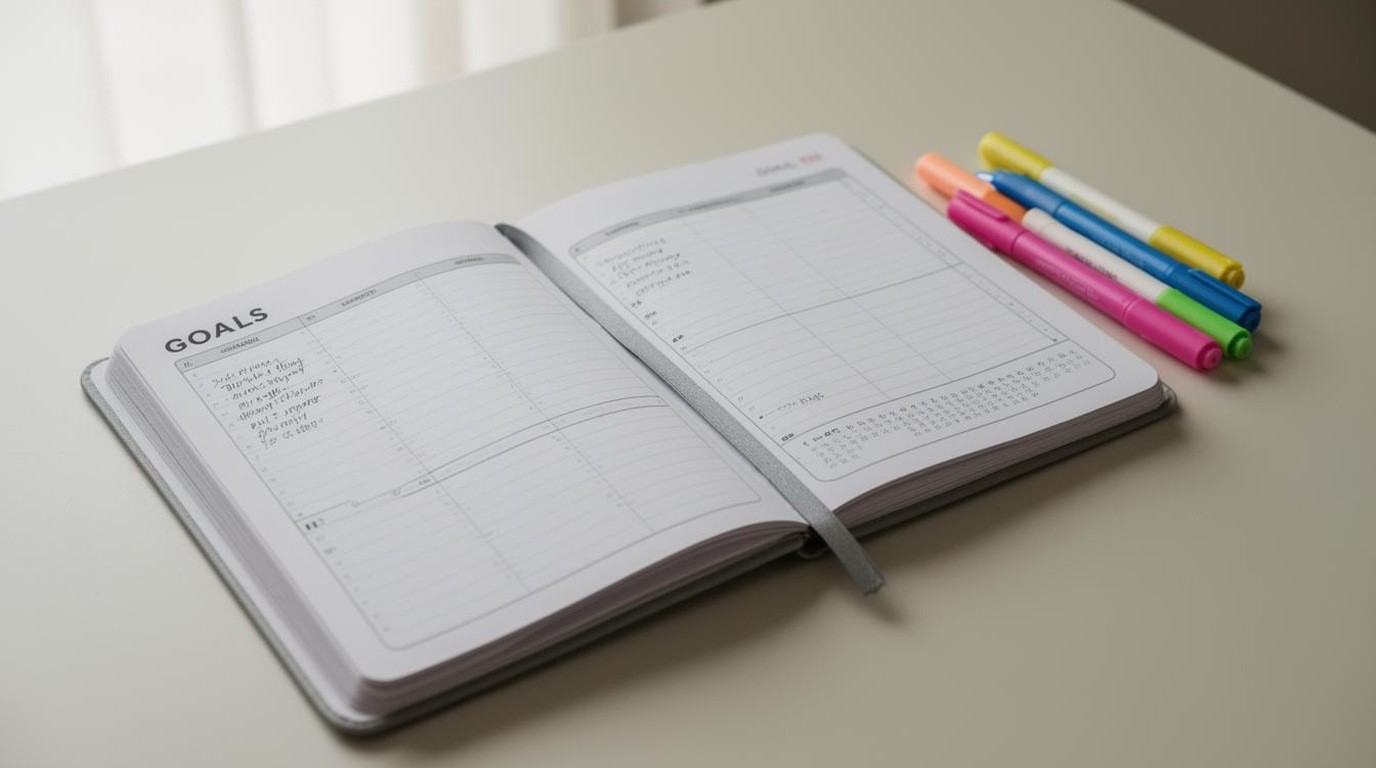
Most New Year goals are written in the last week of December with real enthusiasm and then left untouched until the following December. The problem is rarely the goal. It is the absence of any system for checking progress. A goal that is not reviewed slips away quietly, and the planner that holds it becomes a record of good intentions rather than a working tool.
This guide describes a simple goal system that fits into a planner. It has three loops: a monthly plan that sets the month’s focus, a weekly check-in that asks what happened and a quarterly review that decides what to keep, change or drop. The system is deliberately modest. It is meant to be kept, not admired. It does not promise any particular outcome, since goals depend on the person and the circumstances, and it is not a substitute for professional advice on health, money or work.
A student sets three goals in January, then reviews them only in March. The planner was full of tasks but empty of checkpoints. The system needed a schedule for reviewing progress.
Write fewer goals
A common mistake is to set too many goals at once. Five or six large goals in a single year are hard to track, and the first missed week can make the whole list feel impossible. A better approach is to choose one to three goals that matter most, and to describe each one in a sentence that can be checked.
A useful test is to ask whether you would notice if the goal were achieved. “Get fit” is vague. “Walk three times a week for thirty minutes” is specific. “Read more” is hard to judge. “Read one book a month” can be checked at the end of each month. The aim is a goal that is clear enough to review honestly.
The monthly plan
At the start of each month, write down what you will do this month to move each goal forward. Keep the list short, with two or three actions for each goal. Choose actions you can control, such as scheduling a session, rather than outcomes you cannot control, such as a result from someone else.
Place the monthly plan on a page you will see often. Many planners have a monthly overview or a goals page for this purpose. Some people prefer a single sheet taped inside the cover. The location matters less than the habit of looking at it.
The weekly check-in
Once a week, take ten minutes to review. Ask three questions: what did I do toward the goals this week, what got in the way and what will I change next week. Write the answers in short notes. Do not write a long essay, and do not judge yourself harshly. The check-in is information, not a grade.
Pick a fixed time, such as Sunday evening or Monday morning, so the check-in becomes part of the routine. If you miss a week, do the check-in at the next opportunity. Missing one check-in is normal. Giving up the system after one missed week is the mistake to avoid.
The quarterly review
Every three months, review the goals in more depth. Look at the notes from the weekly check-ins, see where progress was made and where it stalled, and decide what to keep, change or drop. A goal that is no longer relevant should be dropped without guilt. A goal that is stuck may need a smaller step or a different approach.
The quarterly review is also a chance to notice patterns. If the same obstacle appears each week, the system may need a change, such as a different time of day or a smaller commitment. The review turns a year into four shorter pieces, which makes the year feel more manageable.
Habit trackers
A habit tracker is a grid where each day or week has a box to tick when an action is done. Trackers can be useful for daily habits, such as a short walk or a few minutes of practice. They work best when the habit is small and specific. A tracker with too many boxes becomes a source of pressure. Keep it simple, and treat the blank boxes as information rather than failure.
Making the system fit the planner
Your planner may already include sections for goals, monthly plans and weekly notes. If it does not, use a blank page or a separate notebook. The system works in any format as long as the three loops are visible. A planner with a clear monthly page and a space for weekly notes is ideal, though a notebook will serve just as well.
Our guide to layouts for weekly, daily and monthly planning explains which layout suits this system, and digital or paper planner compares paper with an app if you prefer a screen.
When the system breaks down
Life interrupts plans. A family illness, a new job or a change of home can make the system impractical for a while. Accept that, and simplify. Keep only the weekly check-in for a month, or reduce the goals to one. The system is meant to serve your life, not to be a source of guilt.
If the system repeatedly fails, look at the goals. They may be unrealistic, unclear or not truly yours. A goal that is set by someone else, or chosen to impress others, is rarely kept for long. Change the goals before blaming the system.
Things to avoid
- Setting goals that depend entirely on other people.
- Writing goals without any action steps.
- Checking progress only at the end of the year.
- Treating a missed week as a reason to quit.
- Using the system to measure self-worth rather than to plan.
If you are dealing with stress, anxiety or a mental health concern, a planner is not a treatment. Speak to a qualified professional for support.
The short version
Choose one to three clear goals, plan each month with specific actions, check in each week and review each quarter. Keep the system small enough to survive a busy month, and drop or change goals that no longer serve you. A goal system is valuable because it is reviewed, and a review is only possible when the planner is opened.
A starter goal routine
- Choose three goals for the quarter and write them on the first page.
- Review them every week for ten minutes.
- Adjust the goals at the end of each quarter rather than abandoning them.